In the World of Luxury Fashion, Brand Is the Engine of Profitability
When a luxury brand raises its prices year after year and customers keep buying, something beyond product quality is at work. That something is brand.
The luxury industry offers the clearest proof that investment in brand - not just product, not just distribution, not just marketing spend - is what drives extraordinary and sustained commercial performance. And the lessons aren't limited to luxury. They apply to any brand that wants to charge more than the market expects and retain customers who have every reason to shop elsewhere.
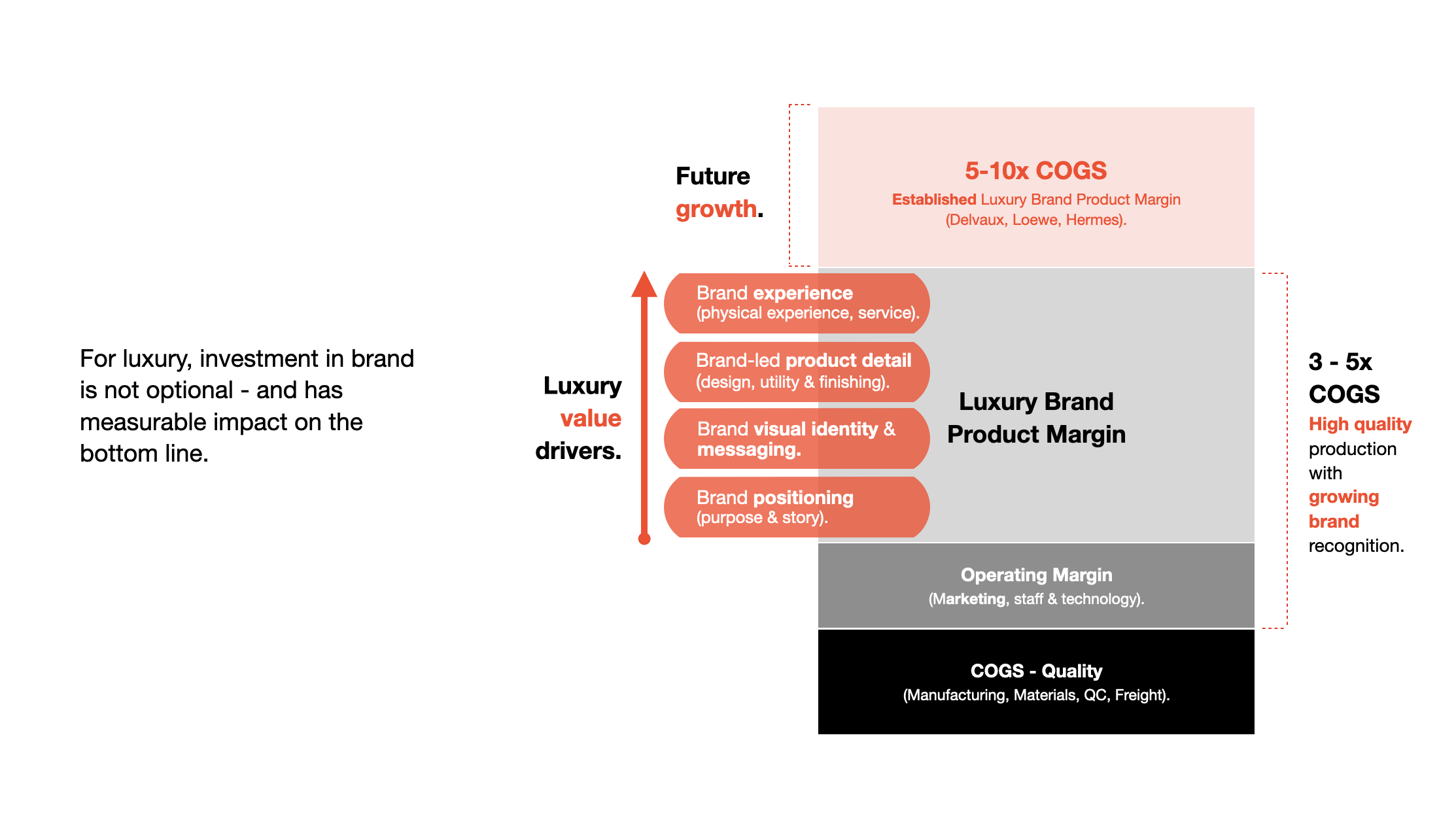
Investment in brand allows luxury fashion brands to 5-10x Cost of Goods Sold (COGS).
The LVMH model: brand as a margin multiplier
LVMH, the world's largest luxury conglomerate, operates 75 brands including Louis Vuitton, Dior, Fendi, and Celine. The group's gross margin has averaged around 68% over the past five years, with the Fashion and Leather Goods division - its most profitable segment - operating at margins historically around 40%, and Louis Vuitton itself reportedly approaching 50%.
To put that in perspective, Louis Vuitton generates over €20 billion in annual sales at margins that most consumer businesses would consider impossible. A handbag that costs a few hundred euros to produce sells for several thousand. The gap between cost and price isn't explained by materials or manufacturing - it's explained by brand.
And this isn't a static picture. Luxury brands have been raising prices consistently, often well above inflation, for decades. Louis Vuitton raised prices during the 2009 recession. It raised them again during COVID in 2020. In both cases, volumes held. Customers didn't just accept the price increases - they continued to buy more expensive items. The brand's pricing power actually accelerated during periods of economic uncertainty, because brand equity functions as a form of insurance: when customers are uncertain, they gravitate toward brands they trust.
LVMH's vertical integration - owning production, distribution, and retail - plays a role in protecting quality and margins. But vertical integration alone doesn't explain the pricing power. Plenty of vertically integrated businesses operate at thin margins. What makes the difference is decades of deliberate, sustained investment in brand: the storytelling, the creative direction, the retail experience, the cultural positioning. Every touchpoint reinforces the same idea - that these products are worth what they cost, and more.
Hermès: proof that brand investment is the most resilient strategy
If LVMH demonstrates the power of brand investment in good times, Hermès demonstrates it in bad times.
The luxury market entered a significant downturn in late 2024 that continued through 2025 and into 2026. LVMH's revenues fell, with a 5.9% decline in Q1 2026 and the group's operating margin contracting from 26.5% in 2023 to 22% in 2025. The Chinese consumer - a critical driver of luxury growth for the past decade - pulled back. Tourism patterns shifted. Consumer confidence wavered.
Hermès, by contrast, posted 6% growth at constant exchange rates in Q1 2026. While LVMH declined, Hermès grew. While other luxury brands discounted or chased volume, Hermès continued its strategy of controlled scarcity, in-house production across its French ateliers, and relentless brand discipline.
What's remarkable is that Hermès achieves this with a fraction of LVMH's scale. Hermès operates under a single brand with revenues of approximately €13.4 billion, compared to LVMH's €80 billion across 75 brands. Yet Hermès commands operating margins around 40% - among the highest in the industry - and a market capitalisation that briefly eclipsed LVMH's in 2025.
The difference isn't product quality alone. Both LVMH and Hermès make exceptional products. The difference is brand discipline. Hermès has maintained a consistent, unwavering brand identity for nearly 190 years. The Birkin bag, the silk scarves, the equestrian heritage - every element tells the same story, reinforced at every touchpoint, decade after decade. There are no flash sales. There are no diffusion lines. There is no dilution.
When the market contracted, that brand discipline became Hermès's greatest competitive advantage. Customers who had multiple luxury options contracted their spending toward the brands they trusted most - and Hermès sat at the top of that list. Brand equity, built over generations, functioned as a buffer against economic turbulence.
KHAITE: the new entrant proving brand matters more than heritage
If LVMH and Hermès represent the established end of luxury, KHAITE represents the insurgent proof that brand investment works even without European heritage or a century of history.
Founded in New York in 2016 by Catherine Holstein, KHAITE has grown from a debut collection of cashmere sweaters and jeans into a global luxury powerhouse. Sales surpassed $100 million in 2022 and have continued to accelerate, with revenues now estimated near $200 million and online sales approaching $2 million per month. Holstein has won the CFDA Womenswear Designer of the Year award two years running. The brand opened stores in New York and Seoul, launched eyewear and a children's line, and attracted investment from the firm Stripes.
What makes KHAITE significant for the brand investment argument is what it doesn't have. It doesn't have European heritage. It doesn't have a century of craftsmanship narrative. It doesn't have the scale advantages of an LVMH or a Kering. What it has is a clear, consistent brand identity - what Holstein describes as a tension between masculine and feminine, fluidity and structure - executed with precision across every touchpoint.
KHAITE's pricing matches or exceeds many European heritage brands. Jeans retail under $500. Most pieces retail above $1,000. The brand has effectively abandoned the assumption that European heritage is a prerequisite for premium pricing. Instead, it has proven that a clear creative vision, consistent execution, and deliberate brand building can command luxury prices regardless of where the brand comes from or how long it's been around.
This matters for every emerging brand, not just those in luxury fashion. KHAITE demonstrates that brand equity is built through clarity and consistency, not through history. You don't need a hundred years. You need a point of view, the discipline to maintain it, and the patience to let it compound.
What this means for growing brands
I was working with an emerging Australian luxury brand last year, a brand with strong product, genuine craftsmanship, and a growing customer base. They were entering their next phase of growth and asked a question I hear frequently: should we lower our prices?
The customer research we conducted told us something consistent with the LVMH, Hermès, and KHAITE stories. Product quality was important to customers, but it was a hygiene factor - every competitor claimed it. What customers actually wanted was a brand that meant something to them. A point of view they could buy into. An identity they could participate in.
The answer wasn't to lower prices. The answer was to invest in brand.
This isn't just a luxury insight. It applies to any business where competition has commoditised the functional value drivers. When every coffee shop has good coffee, the one that wins has a brand that means something. When every fashion label has quality product, the one that grows has a story customers want to be part of. When every SaaS platform has similar features, the one that retains customers has a brand that creates loyalty beyond switching costs.
Brand investment doesn't mean spending more on advertising. It means getting clear on what you stand for, ensuring that clarity is expressed consistently across every touchpoint - from your website to your packaging to your customer service - and having the discipline to maintain it over time, even when short-term pressures tempt you to chase discounts, dilute the range, or chase a trend that doesn't fit.
The brands that invest in this work - the positioning, the storytelling, the experience - are the ones that can raise prices and retain customers. The ones that don't are the ones competing on price, convenience, and range - hygiene factors that are simply the cost of doing business.
LVMH, Hermès, and KHAITE tell us the answer. Invest in brand.
Oliver Smith is an independent brand and marketing strategist based in Melbourne, working with founder-led brands on positioning, growth strategy, and brand transformation. Learn more at oliverstrategy.com.
